Wednesday, June 8, 2011

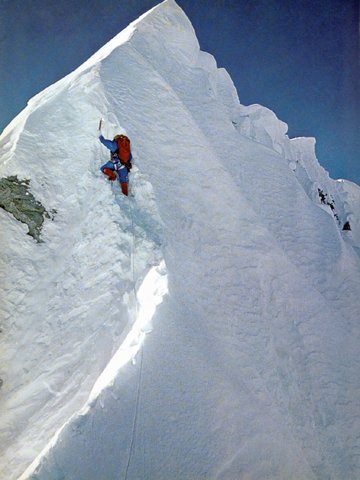
Alpine Ascents Successful Climb of Mount Everest

In brighter news, Seattle-based Alpine Ascents is currently wrapping up a successful summit assault on both Everest and nearby Lhotse a day later. A topological map illustrates the incredible vertical and horizontal distances covered.

Alpine Ascents May 2011 successful summit assaults of Mount Everest and Lhotse

This shows the route from base camp, traversal to Camp I across the Khumbu Icefall, Advanced Base Camp II at 21,000 ft, Camp III at 24,000 ft, Lhotse High Camp, and finally Camp IV at 26,000ft. From Camp IV, the route to the summit ascends 3,000 ft during a grueling 12 hour climb requiring a 9pm departure time to reach the summit by the next morning. The elevation profile shows the several returns to base camp from Camp II during the acclimatization period. It also shows the ascent of Lhotse by three of the climbers from the Everest group prior to the group's descent.

Alpine Ascents does a pretty thorough job listing their itinerary and equipment recommendations. Check it out, particularly the group electronics gear.

Into Thin Air

I recently finished reading Into Thin Air, Jon Krakauer's incredible description of his summit attempt on Mount Everest during what became the 1996 Mount Everest Disaster. The narrative describes Krakauer's experience during the heyday of commercial mountaineering guide services. As a journalist writing for Outside magazine, Krakauer described what was hoped to be a routine climb along Mount Everest's South Col summit route used by Hillary and Norgay during their record-setting first summit in 1953, now the standard route.

During summit day, slow progress by inexperienced climbers and judgment errors by guides set the stage for tragedy when a storm quickly materialized along the southern ridge. Blowing 40 knots and producing incredible wind chills, many tardy climbers including the leader of Krakauer's expedition were trapped high on the upper mountain. By this time, Krakauer himself had nearly made it to high camp in the col and narrowly escaped incredible amounts of exposure in the high winds. Lack of visibility thwarted rescue attempts, and by the next day eight members from two expeditions had perished while others suffered extreme frost bite.

An expedition filming the IMAX documentary Everest offered assistance and supplies such as additional bottled oxygen in addition to arranging a helicopter evacuation of two frost bitten climbers. This film hauntingly documents their perspective of the disaster.

One of the most striking components of this story is how altitude clouded the judgments of the people involved. Several times, someone attempting to adjust their oxygen regulators would get it wrong and either turn off the flow of O2 entirely or drain the tank in minutes. Tragically, one of the guides who had reached high camp during the storm incorrectly stated that all of the oxygen bottles were empty when, in fact, at least two were not. Krakauer speculates this incorrect information changed the plans of Rob Hall, the lead climber, who elected to stay with a client near Hillary Step, just below the summit, where both he and his client perished.

The 1996 Everest Disaster demonstrates the consequences of hubris high on a mountain. One of the guides from an American expedition wasn't climbing with oxygen. While this might be a personal challenge to overcome at other times, doing so while employed to take care of others is exceedingly dangerous. When disaster struck, he was unable to assist; he couldn't even wait around with a distressed climber, for the lack of oxygen slows human metabolism such that the only substantial source of internal heat is produced from muscles as they are operating. Additionally, the many climbers from multiple commercial expeditions created bottlenecks that delayed summit times and increased exposure to weather-related hazards; if the storm had struck even an hour later, many more people are likely to have made it to [limited] shelter in the South Col. Finally, turn around times were ignored at great peril.

One of the other lessons here is no climb is guaranteed, and achieving the summit is only the half-way point. Mountaineering is inherently quite dangerous, particularly above 8000m where oxygen levels are so low that it's virtually impossible to carry someone. Anyone considering undertaking such a venture should come to terms with the fact that rescue is nearly impossible; doubts in one's abilities, fitness levels, and weather conditions should be headed. Underscoring this point, most of the climbing along the upper mountain is done without ropes linking the climbers; falls are so perilous on the steep slopes that doing so would simply increase the scope of one person's tragedy.

Wednesday, May 11, 2011

Coquette

WindFinder is a coquette and a tease. Spectacular sailing conditions are always forecast four days out. When time moves forward, things always settle down to calm conditions that aren't worth the drive up.

Summer must be upon us.

Sunday, April 10, 2011

DEC is Dead

I was perusing Amazon and came upon this title: DEC is Dead. Long Live DEC. This book describes the rise and fall of Digital Equipment Corporation, a legend in the computing industry that introduced many innovations in processor and system design. Many of the architects went on to other companies such as AMD and Transmetta and continued to advance the state of the art. It's an appealing topic, to be sure.

I wanted to point that out.

Additionally, the title seems to confuse the etymological implications of "The x is dead. Long live y." In this case, even if x and y appear to be the same improper noun, lexically, they never refer to the same individual or entity; that'd be a contradiction. The phrase actually refers to a transitional event, where the life of an old entity, x, is over and we should now bestow praise and hope on the life of a new entity, y. See this for a foothold on more information.

I've seen a lot of smart people get this wrong, and evidently someone solidified their mistake as the title of their book. In this case, I suggest DEC is dead. Long live Intel, AMD, and Transmetta.

You're welcome.

Monday, April 4, 2011

Sailing Adventure

Saturday, I went sailing 420s on Lake Lanier with a labmate. Of five boats that went out, we were one of two that didn't both capsize and require a rescue. The other boat that avoided capsize spent much of the morning with only the jib flying and left early.

Winds were intense, from 15 to 20 mph, and waves were high. Our 420 achieved planing speed several times; the sudden boost in speed and rudder authority was reminiscent of a jetski.

Windfinder provides a great and detailed wind forecast.

Thursday, March 10, 2011

Exploring R.M.S. Queen Mary

Bow of RMS Queen Mary

RMS Queen Mary is an ocean liner from the Cunard Line in service from 1936 to 1967. Propelled by four screws, each moved by a collection of high-speed steam turbines, Queen Mary offered the fastest civilian Atlantic crossings available. Her record setting voyage of 3 days, 21 hours earned her the Blue Riband which she held for 14 years. Unlike many of the other liners of the day, Queen Mary survived her service life and found a permanent home along the coast of Long Beach, California, where she now accommodates hotel guests, numerous restaurants, tourists, and a community center built into her forward engine room and aft boiler rooms.

On Sunday morning, I drove up to Long Beach along the Pacific Coast Highway to spend as much of the day as possible exploring Queen Mary's decks and interior spaces, hoping to see as much of the ship as possible. Displacing 81,000 tons and with a length of 1,020 ft, I would surely run out of daylight long before I ran out of things to see.

Hopefully this blog post captures some of the highlights of my visit.

Monday, February 21, 2011

Ferroequinology: More Running Boards

Saturday, I revisited SERM to spend some time on A&WP 290. The previous visit, we cleared several brackets and attached steam and air pipes to expose a nearly clear boiler shell. In preparation for Ultrasonic Thickness testing, a grid over each course of the shell must be arranged and test points ground to expose bare metal. To access the entire shell, running boards on the fireman's (left) side of the locomotive needed to be installed.

Installing the fireman's side running boards used all of the mounting hardware remaining and, to our chagrin, exposed mistakes in mounting the engineer's side running boards. This image depicts the two large castings that support both running boards and compressed air tanks. Each of the four castings is distinct, not correctly labeled, and not easily positioned even with a crane (of which I have become a precise and efficient operator).

Engineer's side running boards on A&WP 290 installed on Jan 15, 2011 at Southeastern Railroad Museum. Pictured: AWP290 project manager Dale Grice.

Ultimately, we had to remove the engineer's side running boards, remove what we guessed was the incorrectly placed bracket, place a different bracket, reinstall the running board, install that bracket on the other side in both possible locations, and hopefully achieve the best fit. Moreover, studs can be bent so it's a matter of luck and judgment to determine whether a part doesn't fit because it's not the correct part or because you're not using a large enough hammer.

By end of day, with many possible combinations attempted, all air tank brackets were soundly mounted, running boards placed, and the boiler now accessible from all sides. During the next disassembly, we'll surely stamp each casting and avoid confusion in the future... ha.

Up next, ultrasonic thickness measurement over every square foot of a 37ft pressure vessel with working pressure 201 psi and operational temperature of 450 degF.